
The 2nd International Conference on Digital Economy and Computer Science (DECS 2025) & the 2025 International Conference on Sustainable Development and Digital Transformation (SDDT 2025) successfully concluded in Wuhan.
Conference Overview
On October 18, the 2nd International Conference on Digital Economy and Computer Science (DECS 2025) and the 2025 International Conference on Sustainable Development and Digital Transformation (SDDT 2025) successfully concluded in Wuhan. The conference was hosted by the School of Computer Science and Artificial Intelligence at Wuhan Textile University, with strong support from renowned institutions including Cleveland State University (USA), Chu Hai College of Higher Education (Hong Kong), Universiti Teknologi Malaysia, University of Salamanca (Spain), and Wuhan Business University. The event attracted numerous experts and scholars from home and abroad to participate online and offline, jointly enjoying an academic feast.
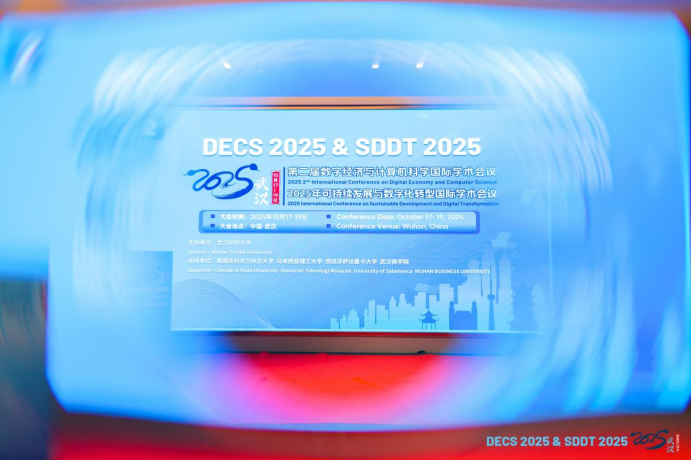
Morning Session: Opening Ceremony & Keynote Speeches
On the morning of October 18, the conference kicked off with a grand opening ceremony. The host extended a warm welcome to the attending leaders, experts, and participants on behalf of the School of Computer Science and Artificial Intelligence at Wuhan Textile University, and introduced the core objective of the conference—to build a high-level international academic exchange platform focusing on frontier topics driven by digital technology, and to promote in-depth dialogue in the fields of digital economy and sustainable development.
Distinguished guests attending the opening ceremony included Professor Dingqiang Duan (Dean of the School of Economics, Wuhan Textile University), Professor Tao Peng (Associate Dean of the School of Computer Science and Artificial Intelligence, Wuhan Textile University), Professor Deshuang Huang (Ningbo Digital Twin Institute, Foreign Academician of the Russian Academy of Engineering, IEEE Fellow, IAPR Fellow), and Professor Xinguo Yu (Central China Normal University, IEEE/ACM Senior Member). Professor Ilan Oshri from the University of Auckland, New Zealand, also participated online. Professor Dingqiang Duan delivered the opening address.
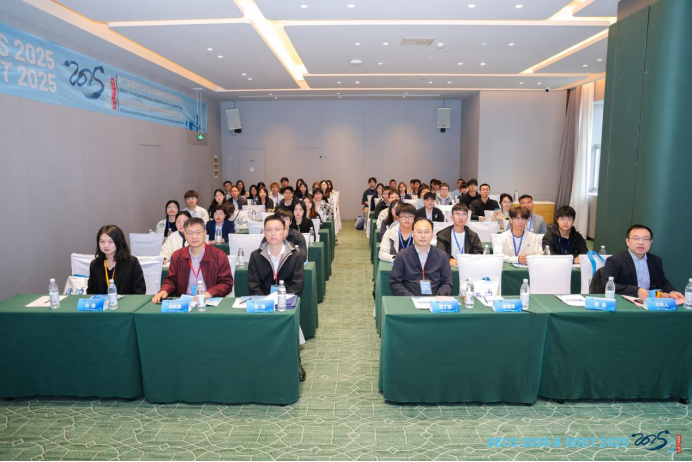
Keynote Speeches
Following the group photo, the conference entered the keynote speech session:
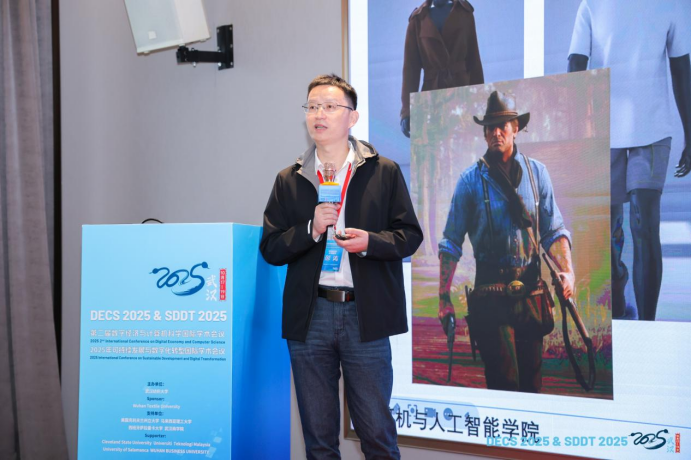
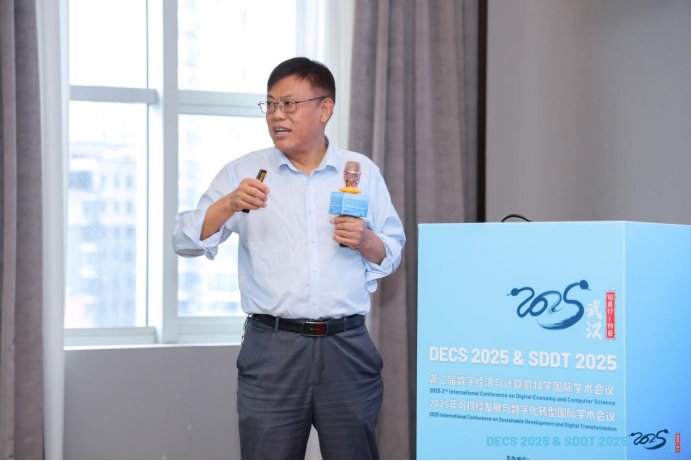
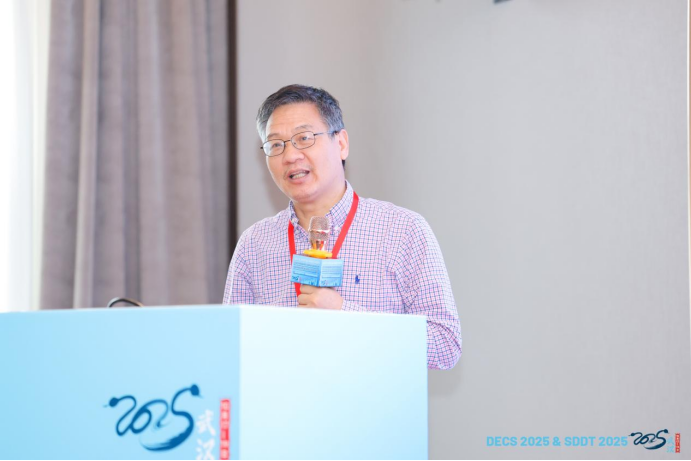
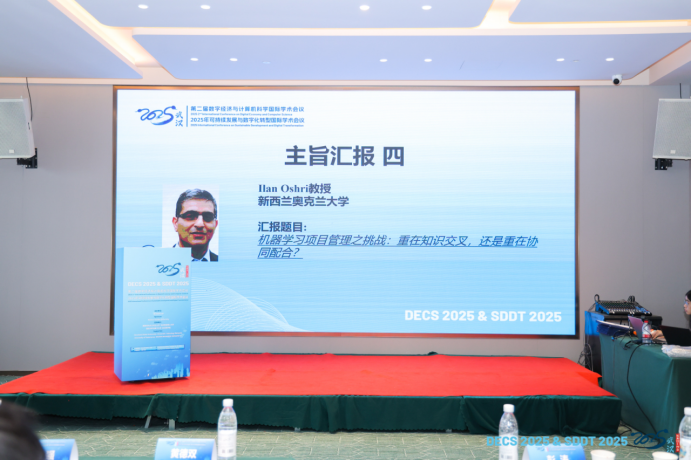
After each presentation, an interactive Q&A session was held, where attendees actively asked questions, creating a strong academic atmosphere. The speakers were also awarded certificates by the organizers in appreciation of their contributions. During the tea break and poster session, participants engaged in in-depth exchanges.
Afternoon Session: Parallel Oral Presentations
At 13:30, the conference simultaneously launched offline and online oral presentation sessions. A total of 23 scholars presented their research findings, with each speaker given 10 minutes followed by a Q&A session.
Offline Session
In the offline session, 8 scholars—including Jingyi Wang from Liaoning University, Chengyun Liu from Chongqing Institute of Engineering, and Heyang Suo from Zhengzhou University of Aeronautics—shared their research on topics such as "The Impact of Trade Agreements on Manufacturing Exports," "Financial Overdue Inference Models," "Anomaly Detection in Corporate Credit Data," and "Green Finance and Carbon Efficiency," covering diverse fields integrating digital technology with economics, finance, and the environment.
Online Session
The online session was conducted via ZOOM. 15 scholars, including Gaotian Zhu from Harbin Engineering University, Feiyan Tang from Qingdao University of Technology, Tong Yang from Chiang Mai University, and Qi Jia from National University of Defense Technology, focused on topics such as "Spatial Mechanisms of Digital Finance," "Data Elements and High-Quality Enterprise Development," "Anomaly Detection in Blockchain Transaction Networks," and "Digital Transformation and Public Opinion Governance." The cross-border academic exchanges broke spatial limitations, with participants interacting actively through Q&A, demonstrating rich research perspectives and solid academic foundations.
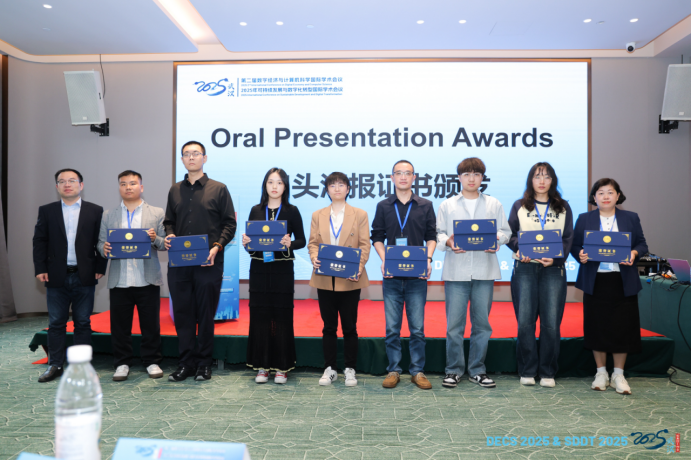
After the presentations, the organizers presented awards to outstanding presenters and took group photos.
Closing Ceremony
In the late afternoon, closing ceremonies were held for both the online and offline sessions respectively. The host, on behalf of the School of Computer Science and Artificial Intelligence at Wuhan Textile University and the organizing committee, expressed sincere gratitude to all attendees, presenters, supporting institutions, and the hardworking staff.
The host stated that through the opening ceremony, keynote speeches, oral presentations, and poster sessions, the conference built an efficient exchange platform for scholars at home and abroad. It showcased cutting-edge research in digital economy, computer science, sustainable development, and digital transformation, laying a solid foundation for future academic cooperation and technological application."Though the grand event concludes, the pursuit of academia knows no bounds."We look forward to gathering with fellow scholars again to explore more possibilities for digital technology empowering sustainable development.
With the host's announcement, the one-day academic event, DECS 2025 & SDDT 2025, officially drew to a successful close.